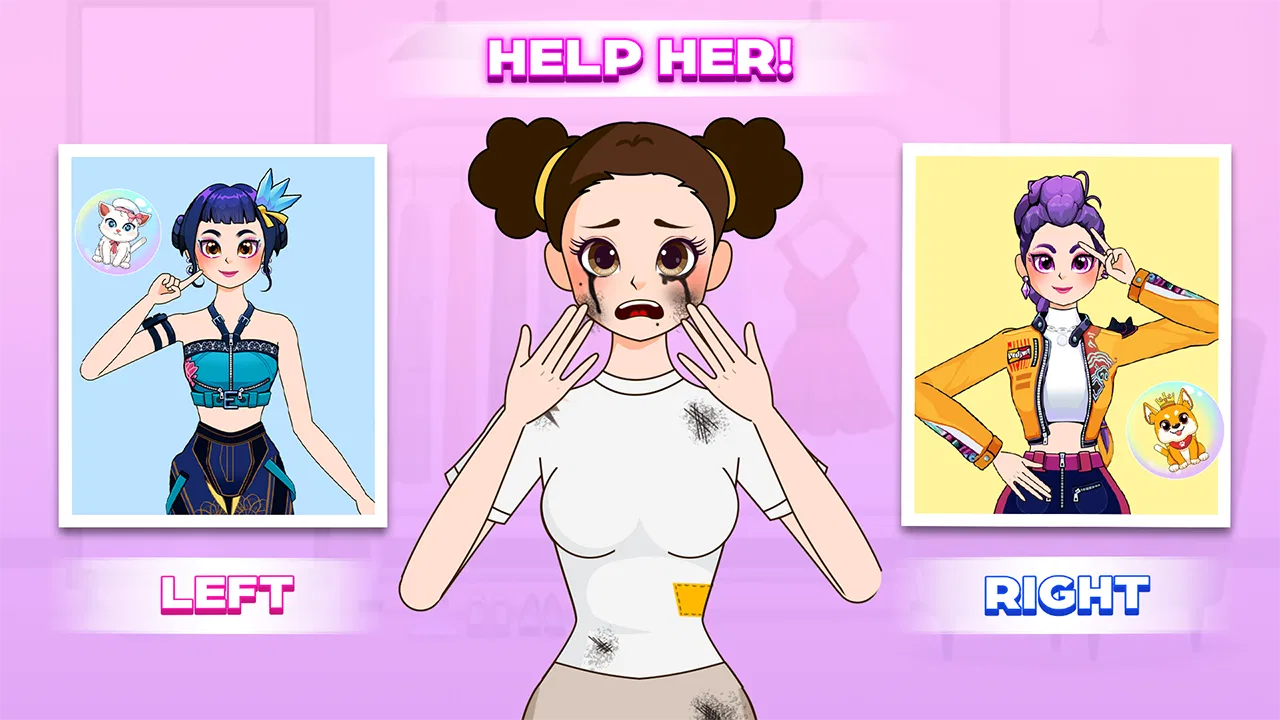
Left or Right: Star Girl Style
- 3.8
- Rating
- 10.00M
- Installs
- Free
- Price

 Analysis by App-foxy
I spent time with Left or Right: Star Girl Style as a light fashion game, and my first impression was that it understands the appeal of making quick visual choices. The basic idea is easy to grasp: you are presented with style decisions and asked to choose between the left or right option, gradually shaping a look that feels suitable for the moment. It is the kind of game I can open when I have a few spare minutes, make a handful of choices, and put down without needing to remember a complicated story or control scheme.
That simplicity is both its strongest quality and its main limitation. JUMBO GAMES Studio has made a casual experience aimed at immediate interaction rather than deep fashion simulation. You do not need knowledge of clothing brands, color theory, or competitive gaming to understand what is happening. At the same time, players looking for detailed outfit construction, a large creative toolkit, or a demanding challenge may find the format narrower than expected.
How the first choices create a clear goal
The early appeal comes from having a very understandable objective: make decisions that move a character toward a convincing style. The store summary describes mixing and matching while taking on fashion battles, but in practice the important part for a new player is the short decision loop. I look at the available alternatives, decide which one fits the developing outfit, and see whether the result feels more coherent than the previous choice.
You May Also Like

 Google Keep - Notes and lists
Google Keep’s Quiet Growth Shows the Appeal of Simpler Notes
As mobile work gets busier, Google Keep keeps winning a simple contest: capture a thought quickly, find it later, and get on with the day.

 Blood Strike: 2.5 Anniversary
Blood Strike’s Loadouts Turn Every Drop Into a Tactical Gamble
A close look at Blood Strike’s custom loadouts: how fast access to signature weapons reshapes its battle royale rhythm, rewards preparation, and narrows the gap between fights.

 Pandora - Music & Podcasts
Pandora’s Music Is Easy to Start, but Harder to Recover
Pandora’s strength is its low-effort path from a seed to a station. Its weak spot is how much confidence it asks you to place in connection, setup, and quiet recovery.

 8 Ball Pool
 Is Built on Rivalries, Rematches, and Routine
A close look at the rivalries, rematches, shared routines, and unanswered safety questions that turn a quick pool match into a persistent mobile community.

 Samsung Music
’s Quiet Strength Is Playing What You Already Own
Its reach comes less from spectacle than from dependable access to a personal library. That simplicity is both the app’s strongest retention engine and its ceiling.

 AccuWeather: Weather Radar
AccuWeather Review: A Quick, Clear Forecast for Everyday Decisions
For everyday plans, the best forecast is the one you can understand quickly. AccuWeather makes rain timing, radar, and local conditions easy to act on, with a few trade-offs.
More From Our News Desk



This gives the opening sessions a small but useful goal. I am not trying to master a complicated menu or learn a long list of rules. I am simply trying to make better styling judgments from one screen to the next. That makes the game approachable for younger players and for anyone who enjoys visual comparison without wanting a serious time commitment. Its Everyone age rating also fits that accessible presentation.
The left-versus-right format makes the first few moments especially easy to follow. There is no need to search through a wardrobe before understanding the basic interaction. The decision is placed directly in front of me, which keeps the focus on recognition and preference. A useful way to play is to pause briefly before tapping and ask what the outfit is trying to communicate: casual, polished, bold, or coordinated. That small habit makes the choices feel more deliberate instead of completely random.
One detail I appreciated is that the opening does not demand that I already know what counts as a “correct” fashion answer. I can approach each choice through color, silhouette, occasion, or simply personal taste. That makes it friendlier than fashion games that immediately bury the player under inventories and customization panels. The trade-off is that the game’s goals can feel light. The satisfaction comes from seeing a look take shape, not from solving a complex puzzle with many interacting rules.
For an everyday example, I could play it while waiting for a coffee or during a short break between tasks. I would not need headphones, a long uninterrupted session, or a plan for managing resources. The game works best in that space: a quick visual distraction where each decision gives me a small reason to continue.
What progress feels like during a session
Progress in a game like this is communicated less through complicated statistics and more through visible change. Each choice alters the direction of the outfit, so the developing appearance becomes the main signal that I am moving forward. I found that more motivating than a bare sequence of identical screens because the character’s look gives the session a sense of destination.
The important question is not only whether I can keep tapping. It is whether the game gives me enough feedback to care about the next choice. When the styling feels cohesive, I naturally want to see the finished result. When an earlier decision looks less convincing, I become curious about whether later options can recover the overall impression. That creates a modest form of tension without requiring a complicated narrative.
I would describe the progress as immediate rather than long-term. The reward is tied closely to the current fashion sequence, so the game is easy to understand but not necessarily built around a deep personal collection or elaborate character development. Players who enjoy seeing a quick before-and-after transformation will probably respond well. Players who need persistent upgrades, extensive avatar ownership, or a strong sense of account-wide advancement may want a more substantial dress-up title.
A practical tip is to judge the whole outfit rather than choosing each item in isolation. A piece can look attractive by itself but clash with what has already been selected. I found that thinking about balance—such as whether one dramatic element needs simpler companions—makes the decisions more interesting. This also exposes one of the game’s subtle trade-offs: it encourages visual judgment, but the available choices still define the limits of that judgment.
The game’s current version is 0.28, which places my experience in a product that is still relatively focused rather than a huge fashion platform. I would approach it as a compact casual game, not as a replacement for a full creative editor. That expectation matters because the enjoyment comes from the rhythm of choices and outcomes, not from unlimited control over every detail.
Where the challenge comes from
The challenge is gentle at first, which is appropriate for a game designed around fast decisions. Early play is more about understanding the visual language than overcoming a punishing obstacle. I can learn what kinds of choices produce a satisfying result simply by continuing through the sequence, and that low barrier makes the game comfortable for players who do not usually play games.
As the choices become less obvious, the challenge shifts toward consistency. It is easy to select something I personally like, but a stronger decision considers the direction already established. This is where the game can reward attention: the best option is not always the most eye-catching item on the screen. Sometimes a quieter choice supports the rest of the outfit better.
That said, I would not call the difficulty demanding in the same way as a puzzle game or a competitive strategy game. The pressure is mostly about making a pleasing series of decisions, not surviving a complex ruleset. If you are looking for strict timing, layered resource management, or a high-skill mastery curve, this is probably not the right choice. Its challenge is visual and situational, with a relaxed pace that favors experimentation.
One useful way to keep the experience fresh is to alternate between two mindsets. In one round, I can optimize for what seems most coordinated. In another, I can deliberately choose the bolder option and see whether the final style still works. This turns repeated sessions into small experiments rather than a hunt for one supposedly perfect answer. It also helps reveal whether I am enjoying the decision-making itself or only waiting for the final reveal.
The game is therefore strongest for players who like low-stakes judgment calls. It can be a pleasant introduction to fashion-themed games for a child, a casual player, or someone who enjoys makeover content but does not want to manage a large wardrobe. It is less suitable for someone who wants every item to be freely placed, recolored, layered, and adjusted with precision.
Pacing, repetition, and the reason to return
The pacing is brisk enough to support short sessions. I never feel that I need to dedicate a full evening to understand the game’s appeal. A few decisions can form a complete mini-experience, which is valuable on a phone. The downside is that this same compact structure can make repeated play feel familiar quickly if the visual decisions do not continue to surprise me.
That is the central retention question for Left or Right: Star Girl Style. Does the next choice feel meaningful enough to justify another round? For me, the answer depends on mood. When I want a quick fashion-themed distraction, the format works well. When I am seeking a long-term project with a strong sense of ownership, the short loop does not provide the same pull as a larger dress-up or avatar game.
The game’s fashion-battle framing gives each sequence a little more purpose than simply browsing outfits. It suggests that choices are being judged within a style context, which makes coordination matter. Still, I would not expect the competitive idea alone to carry endless sessions. The lasting appeal comes from the combination of quick decisions, visible outfit development, and curiosity about the next set of alternatives.
There is also a useful difference between playing casually and playing critically. A casual session is about tapping the option that looks best to me and enjoying the result. A more engaged session asks why one option works better: does it match the existing colors, preserve the intended mood, or create too much visual noise? The second approach gives the game more depth than its simple controls suggest, although that depth comes from the player’s attention rather than from a complicated rules system.
I would skip it if I dislike repeating short choice sequences or if I need a clear long-term target before I can enjoy a game. The title is not likely to satisfy players who prefer lengthy campaigns, detailed simulation, or constant mechanical escalation. It is also not the best alternative for someone who wants a pure creative sandbox, because choosing between presented options is more restrictive than designing an outfit from an empty canvas.
How it compares with other casual fashion games
Compared with traditional dress-up apps, this game feels more guided. A typical wardrobe-focused alternative may let me browse many garments, change accessories, adjust colors, and spend time refining one character. Left or Right: Star Girl Style reduces that freedom in exchange for speed. I make a decision, see the effect, and move on. That makes it easier to start but gives me less control over the final composition.
Compared with puzzle-oriented casual games, its challenge is more subjective. There is no need to calculate moves or memorize a complex pattern. The question is whether the selected style makes sense in context. That can be more relaxing, though it may also feel less satisfying to players who want unambiguous wins and losses.
Compared with narrative fashion games, the emphasis here is on the styling interaction rather than on following a deep character story. I would choose this one when I want immediate play and visual feedback. I would choose a story-heavy alternative when the relationships, dialogue, and world matter as much as the clothing.
Its strongest practical advantage is accessibility. The game is free, supports devices running Android 8.0 or later, and has passed the threshold of over ten million installs, so it is clearly aimed at a broad mobile audience. The average rating sits at 3.8 from roughly fourteen thousand ratings, which suggests a generally mixed-to-positive reception rather than universal enthusiasm. I read that as a reminder to keep expectations realistic: the core idea has reach, but the simple format will not suit everyone.
The developer, JUMBO GAMES Studio, has positioned the experience firmly in the casual space. That is a good fit for the controls and session length. It also explains why I would not judge it by the standards of a full fashion design tool. The right comparison is another quick mobile game, not professional styling software or a deep avatar creator.
Who will enjoy it, and who should pass
I would recommend it to players who like makeover themes, quick visual choices, and games that can be played in short bursts. It is especially approachable for someone who wants to try a fashion game without learning a large inventory system. Families looking for an Everyone-rated casual title may also find the basic premise easy to share, although individual enjoyment will still depend on whether the player likes making style judgments.
It is a good fit for a short daily routine: play a few sequences during a commute break, use it as a mental reset after work, or let a child make choices while discussing why one outfit looks more balanced than another. That last use case is more interesting than it sounds, because the game can encourage observation and explanation without turning the activity into a formal lesson.
I would recommend skipping it if your priority is deep customization. The left-or-right structure means the game is about selecting among presented directions, not building every detail from scratch. I would also look elsewhere if you need a strong sense of permanent progression, a demanding difficulty curve, or a competitive system that rewards advanced mastery. The game’s appeal is immediate and visual, so its limitations become obvious when those are the features you value most.
Because it is free, the entry barrier is low, but free access does not automatically make every casual game worth keeping installed. My advice is to judge it after a few sessions by asking whether the choices remain interesting after the novelty of the first outfits fades. If I am still comparing color balance and overall mood, it has earned a place as a small time-filler. If I am tapping without caring about the result, the format has probably reached its limit for me.
My verdict on the progression and pacing
Left or Right: Star Girl Style succeeds when it keeps the focus on one clear action: choose the option that best moves the look forward. Its early goals are understandable, its progress is visible through the changing outfit, and its difficulty stays welcoming rather than intimidating. The fashion-battle framing adds direction, while the short sessions make it easy to fit into ordinary routines.
My main reservation is that the same simplicity that makes it accessible can reduce its staying power. The game offers a guided fashion experience rather than a complete design studio, and I would not install it expecting a deep progression system. Its retention depends on whether I enjoy making repeated style calls and watching them combine into a finished result.
Overall, I see it as a pleasant casual game for quick fashion decisions, not a definitive dress-up experience. If you want fast, low-pressure outfit choices with a clear visual payoff, it is worth trying for free. If you want extensive control, complex goals, or a demanding challenge, a more feature-rich alternative will be a better match. For the right player, though, its focused left-or-right loop is exactly what makes it easy to pick up and enjoy.
FAQs for Left or Right: Star Girl Style
01What is Left or Right: Star Girl Style about?
Left or Right: Star Girl Style is a fashion-themed game where players make style decisions for their character to climb the celebrity ladder. Players engage in various activities like choosing outfits, participating in fashion shows, and interacting with other characters to gain popularity and unlock new levels.
02Is Left or Right: Star Girl Style free to play?
Yes, the game is free to download and play on both Android and iOS platforms. However, it contains in-app purchases that offer additional features, outfits, and customizations. These purchases can enhance gameplay but are not necessary to enjoy the core experience.
03What are the system requirements for installing the game?
For Android users, the game requires a device running Android 5.0 or higher. iOS users need iOS 9.0 or later. It’s compatible with most smartphones and tablets, but a stable internet connection is recommended for the best experience, especially during updates and in-app purchases.
04How does the gameplay work in Left or Right: Star Girl Style?
Players make choices that influence their character’s fashion journey. The game involves selecting outfits, participating in challenges, and interacting with other characters, which affects the storyline and character development. Players must strategically choose options to boost their character’s fame and unlock new levels.
05Can I play Left or Right: Star Girl Style offline?
While some features of the game can be accessed offline, a significant portion of the content requires an internet connection. This includes participating in events, purchasing items from the store, and accessing social features where you interact with other players or updates.
Pros
- Intuitive user interface design.
- Engaging fashion challenges.
- Diverse wardrobe options.
- Regular updates with new styles.
- Easy to navigate menus.
Cons
- Requires internet connection.
- Some content behind paywall.
- Occasional in-app ads.
- Limited customization options.
- Battery usage can be high.

Left or Right: Star Girl Style
Gallery